
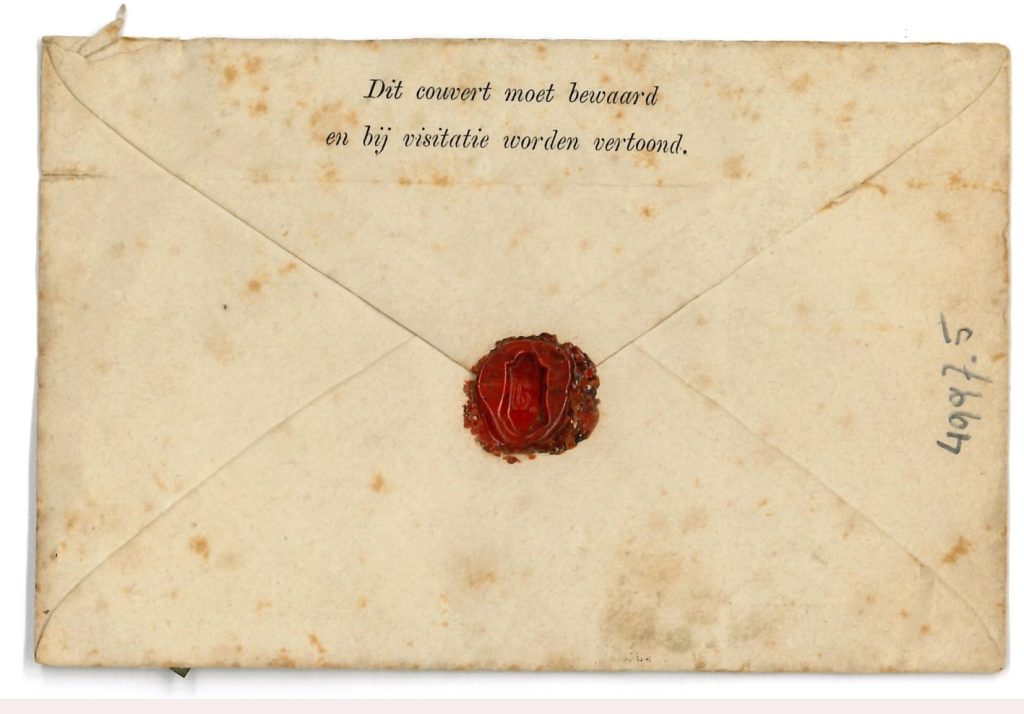
Rotterdam Weight Office, Calibration Report for Weight Box, Envelope with Wax Seal and Weight Description, December 10, 1885 PHOTO Amsterdam Museum, obj. no. 4977.5
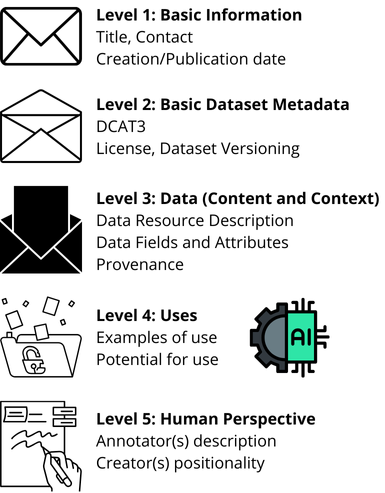
Maria Eskevich, Infographic comparison (meta)data standards 2024
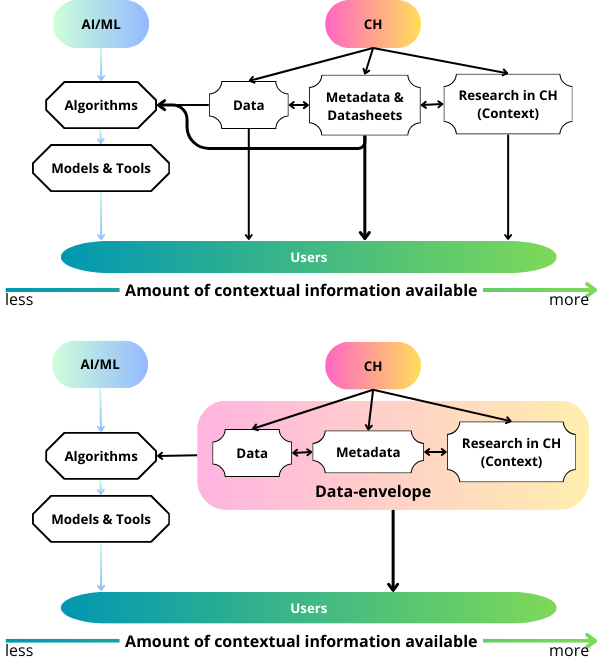
Maria Eskevich, Infographic data envelopes structure, 2024
Project
Access to Context: Data Envelopes for Digital Cultural Heritage in Practice
ROYAL NETHERLANDS ACADEMY OF ARTS AND SCIENCES – Huygens Institute
In the humanities and heritage sector, numerous datasets are becoming available for research and interdisciplinary use, partly due to data-driven innovations and new digitisation technologies. At the same time, the digital processing of data on cultural heritage objects is not documented in a comparable way in most projects, and current metadata models and various dataset registries do not offer sufficient scope for adequate description. To address this problem, consensus and support are needed for an overarching descriptive model for dataset discovery that facilitates finding, sharing, and reusing data. This project aims to develop a metadata format that reflects the complexity and heterogeneity of cultural heritage data and helps make datasets discoverable through the principles of FAIR and Open Science.
Data envelopes
So-called datasheets map the characteristics of a data object, dataset, or software system to add context and, in particular, to summarise technical and commercial information. Analysis and experiments at the Huygens Institute, in consultation with other partners in the field, have shown that current datasheets are insufficient to adequately express the complexity and heterogeneity of cultural heritage data. Therefore, the Huygens Institute has introduced the new concept of data envelopes. These specifically provide space for information that is of particular importance to this field; for researchers, the wider public, and for machines. For instance, data envelopes also incorporate information about provenance (in what context did these sources originate), context surrounding the FAIR principles (where can the data be found, for example, and in what format; what does someone need to know for reuse of the dataset), and positionality (who has worked on it and what might that say about bias and blind spots). Furthermore, data envelopes add aspects (in addition to other datasheets) that are genuinely machine-readable, thereby enhancing interoperability with other systems and discoverability.
Objective and result
This project, in collaboration with the Amsterdam City Archives and the Netherlands Institute for Sound and Vision, has two objectives. Firstly, the project is focused on the applicability of data envelopes for other types of data (such as audiovisual data, photo archives, and administrative datasets); secondly, on the identification of technical requirements for preserving and sharing data envelopes (within organisations and) via external catalogues. These activities will result in a data envelopes proof by the end of 2025.