
Project
Victory Boogie Woogie In Detail
The Hague Museum of Art
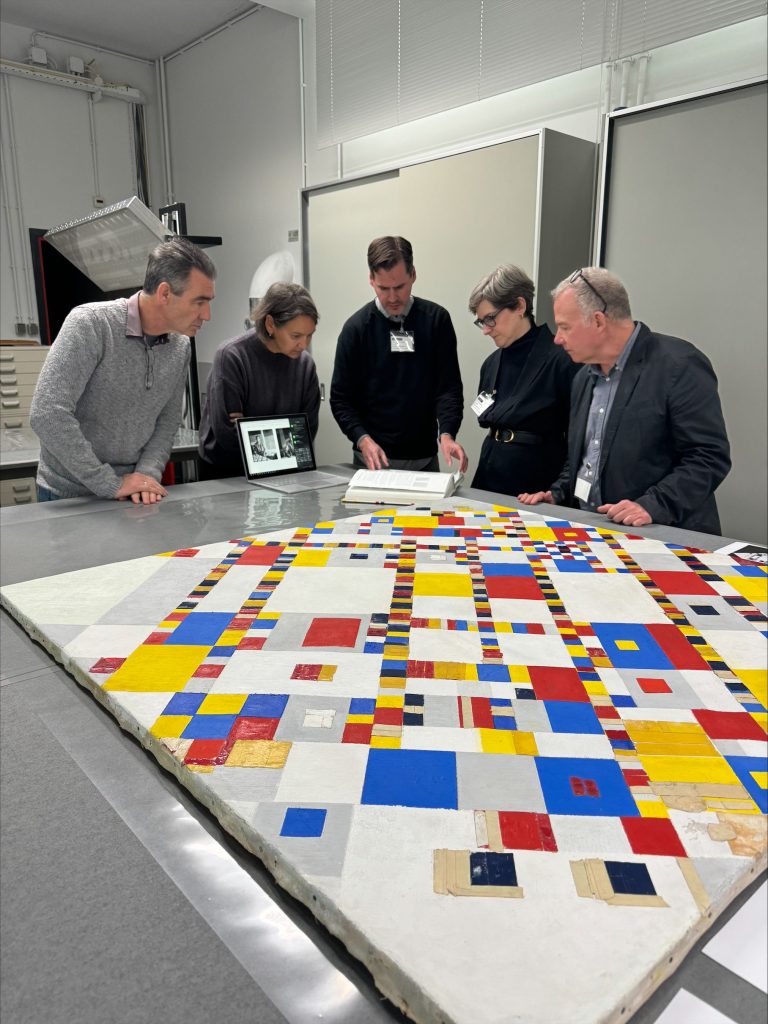
Between 2006 and 2012, a team of international experts extensively studied Victory Boogie Woogie (1942-1944), a painting by Dutch artist Piet Mondriaan, at the Kunstmuseum Den Haag. The results of the multidisciplinary research have been published in the book Victory Boogie Woogie Uitgepakt (Amsterdam University Press, 2012).
However, the large amount of technical research data generated by the project has not been adequately secured and is not accessible. The project's aim – Victory Boogie Woogie in detail – is to fully map, document, metadata, and sustainably make accessible the research data sixteen years later via the RKDtechnical database.
Between 2006 and 2012, a team of international experts conducted extensive research into the painting Victory Boogie Woogie (1942-1944) by Dutch artist Piet Mondrian at the Kunstmuseum in The Hague. The results of this multidisciplinary investigation were published in the book Victory Boogie Woogie Unpacked (Amsterdam University Press, 2012).
However, the huge amount of technical research data generated during this exercise is inadequately secured and remains inaccessible. Sixteen years on, the aim of the project Victory Boogie Woogie in Detail is to map and document that data, to add metadata and so make it as accessible as possible via the RKDtechnical database.
This will ensure that the information becomes permanently available to future researchers. The project is a collaboration between the RKD-Netherlands Institute for Art History, the Kunstmuseum and the Cultural Heritage Agency of the Netherlands (RCE).
Victory Boogie Woogie , the last painting by Piet Mondrian (1872-1944), is part of the permanent collection of the Kunstmuseum Den Haag (formerly the Gemeentemuseum Den Haag). A large-scale study of the materials and construction of this famous painting was carried out between 2006 and 2008, in a collaboration between the museum and the Cultural Heritage Agency of the Netherlands. Visitors were able to watch the team of international scientists at work from behind a glass wall.
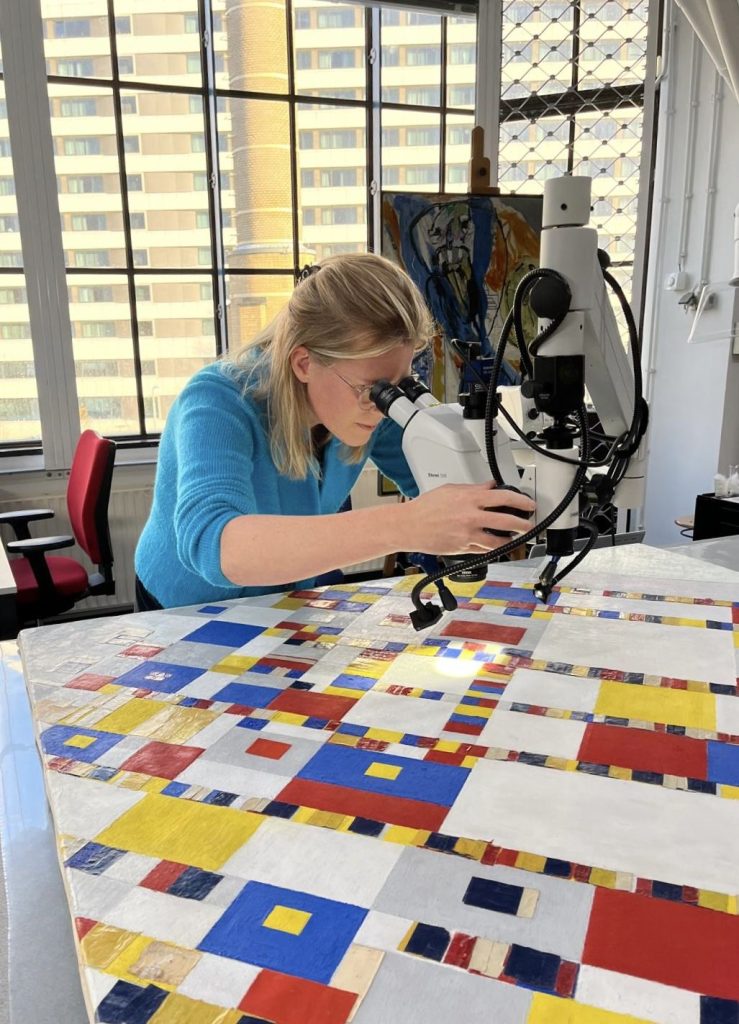
The research constituted a case study within the EU-ARTECH programme, in which MOLAB (a mobile laboratory for non-evasive research) was used to carry out the analytical research in the museum’s exhibition space. All the ingredients for an interesting study were present: besides paint, the artist also used relatively unknown materials, such as adhesive tape. Employing a special technique, he scraped away paint and left the canvas unfinished, without varnish. It was precisely this ‘unfinishedness’ that provided researchers, conservators and curators with the clues they needed to trace the chronology of the work’s creation and gain new insights into Mondrian’s working methods. In addition to the technical research, source research and research into the painting’s restoration history were also carried out.
Lines and fields
By studying the painting’s material composition and layer structure, the scientists wanted to learn more about how the work was created. In order to compare the colour fields, it was necessary to accurately identify the materials used. Spectral measurements made it possible to group colour fields, while oblique light was used to map variations in surface elevation. Thanks to these techniques, the researchers were able to discover that the painting’s current appearance largely matches the painter’s original intention. The first pencil lines, drawn by Mondrian as early as 1942, coincide with the painted line pattern.
Mondrian decided on the positions of the large grey and white areas early on and did not change them. It appears that the positions of the large blue, red and yellow areas were also locked in at an early stage, although Mondrian did continue to search for the right tone: in some fields, as many as seven layers of blue paint were found. Within the fixed elements, Mondrian mainly played with the colour and position of the smaller fields. A relatively large amount of adhesive tape – a tool the artist used to quickly adjust his compositions – was found in these areas.
Publication
The results of the study were published in the book Inside Out Victory Boogie Woogie by Maarten van Bommel (then RCE), Hans Janssen (Kunstmuseum Den Haag), Ron Spronk (Radboud University Nijmegen) and others. The book has also been published in English:
.